
In the Studio
Gathering your data - Making Connections
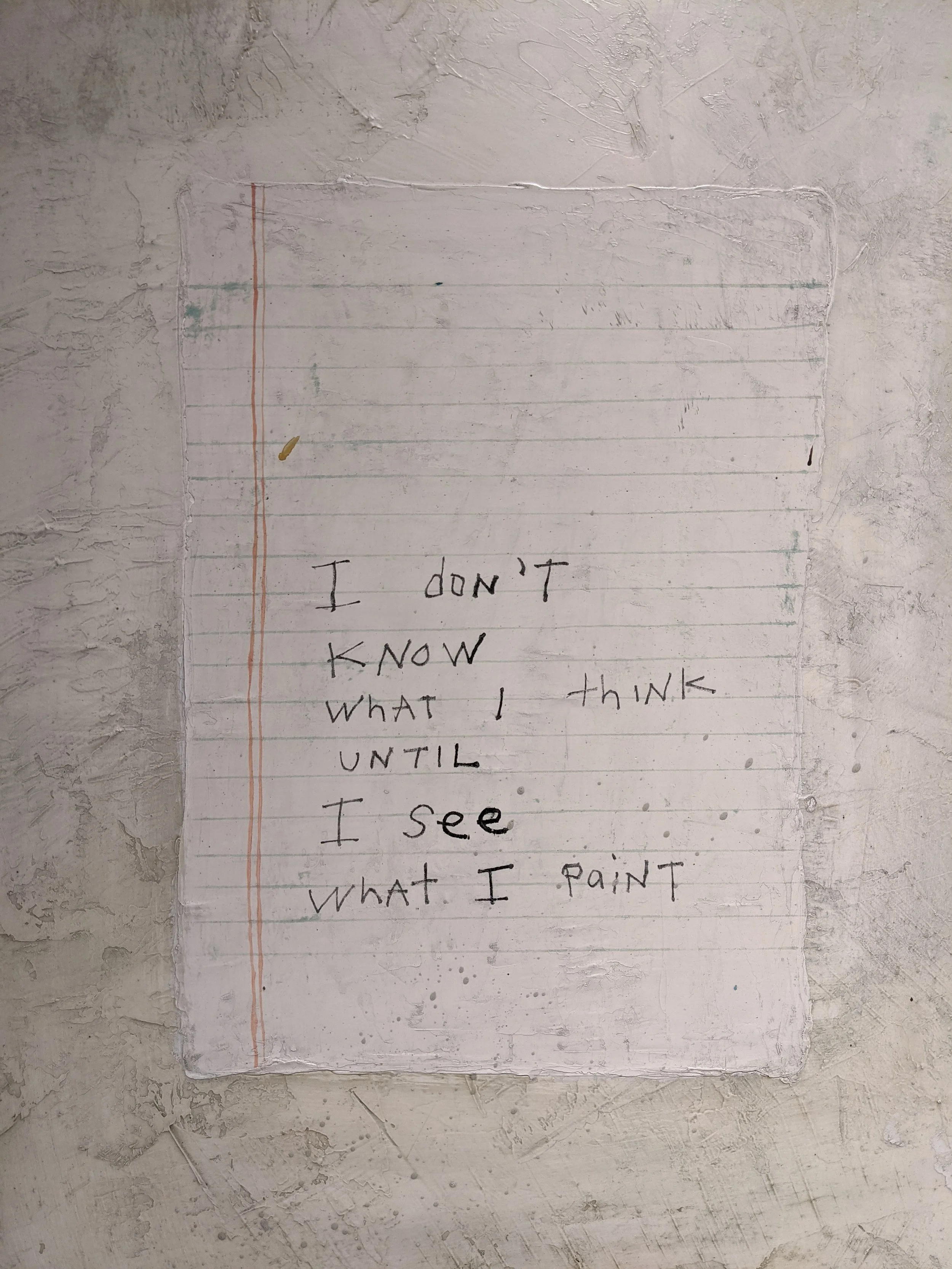
Detail of a Squeak Carnwath painting
As we near the end of our term and year together, give yourself this gift of some dedicated reflection time.
Begin by gathering everything you have done over the last year, drawings, paintings, studies, abandoned experiments, and hang them all up on a wall. Carve out a chunk of time in your life and a chunk of some wall or floor. Get some coffee, a pencil and paper. Take a seat and let the visual journey wash over you.
Start adding some language to your sketch book that comes up for you about your impression of all these moments bumping up against each other.
Be like a detective, gathering all your clues, connecting dots, building evidence. A window into your internal world.
Some reflections you might find helpful:
What formal elements seem important/repeated? i.e., value/tone, limited temperature vs full chroma, cubist/modernist space vs. representational/atmospheric space.
What new questions emerge for you?
What poetic themes/concepts emerge? ie: abundance/decay, interior/exterior, unity/chaos, tactile/ephemeral, etc.
What materiality feels important to you? ie, loose vs. structured, slow vs. fast, thick vs. thin. Oils, drawing, collage, Gouache?
Gathering your data
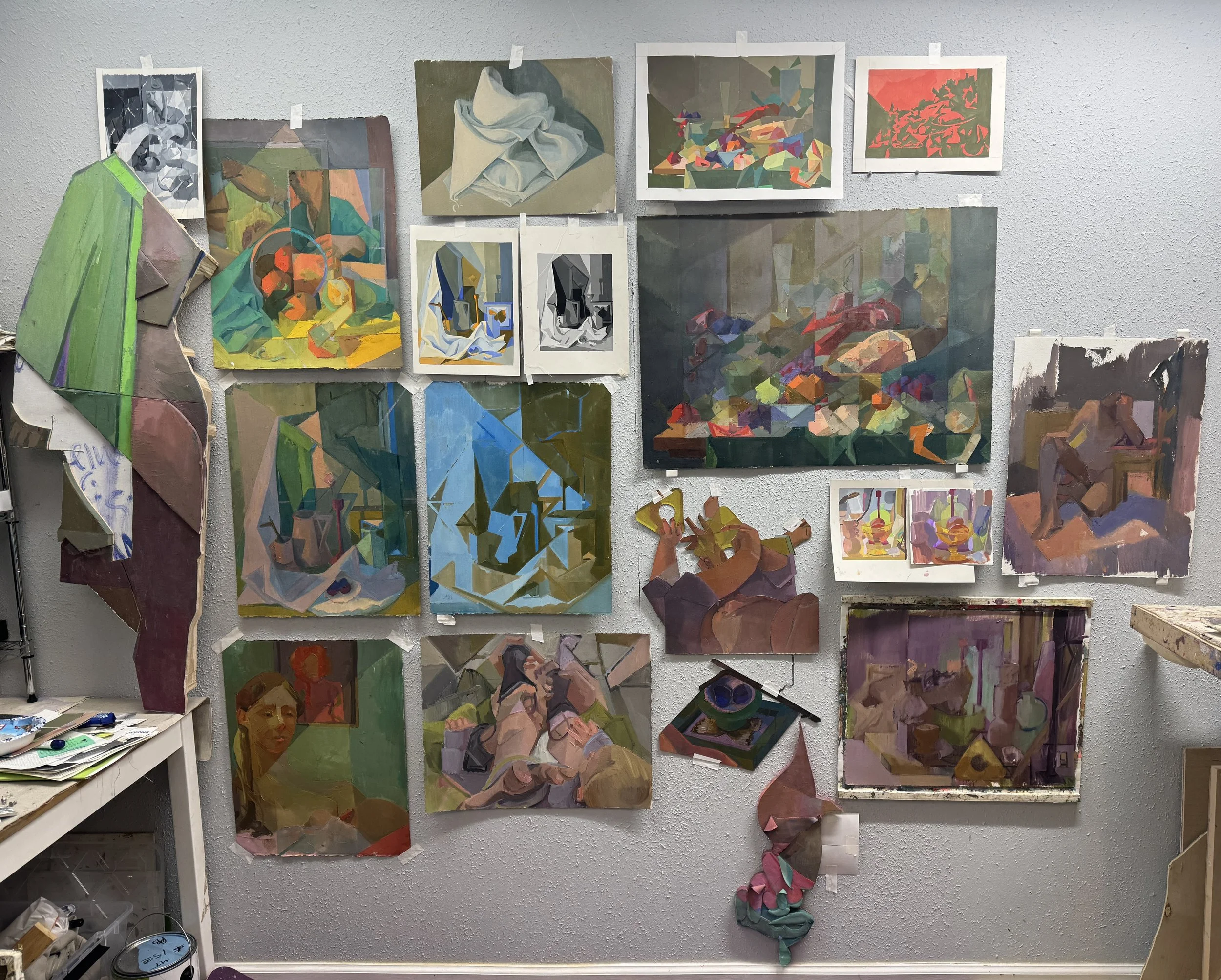
Here is a gathering of my fragments from the past year (ish) selected the works that felt poetically and materially important to me, some of them class work, some of them other studio work.
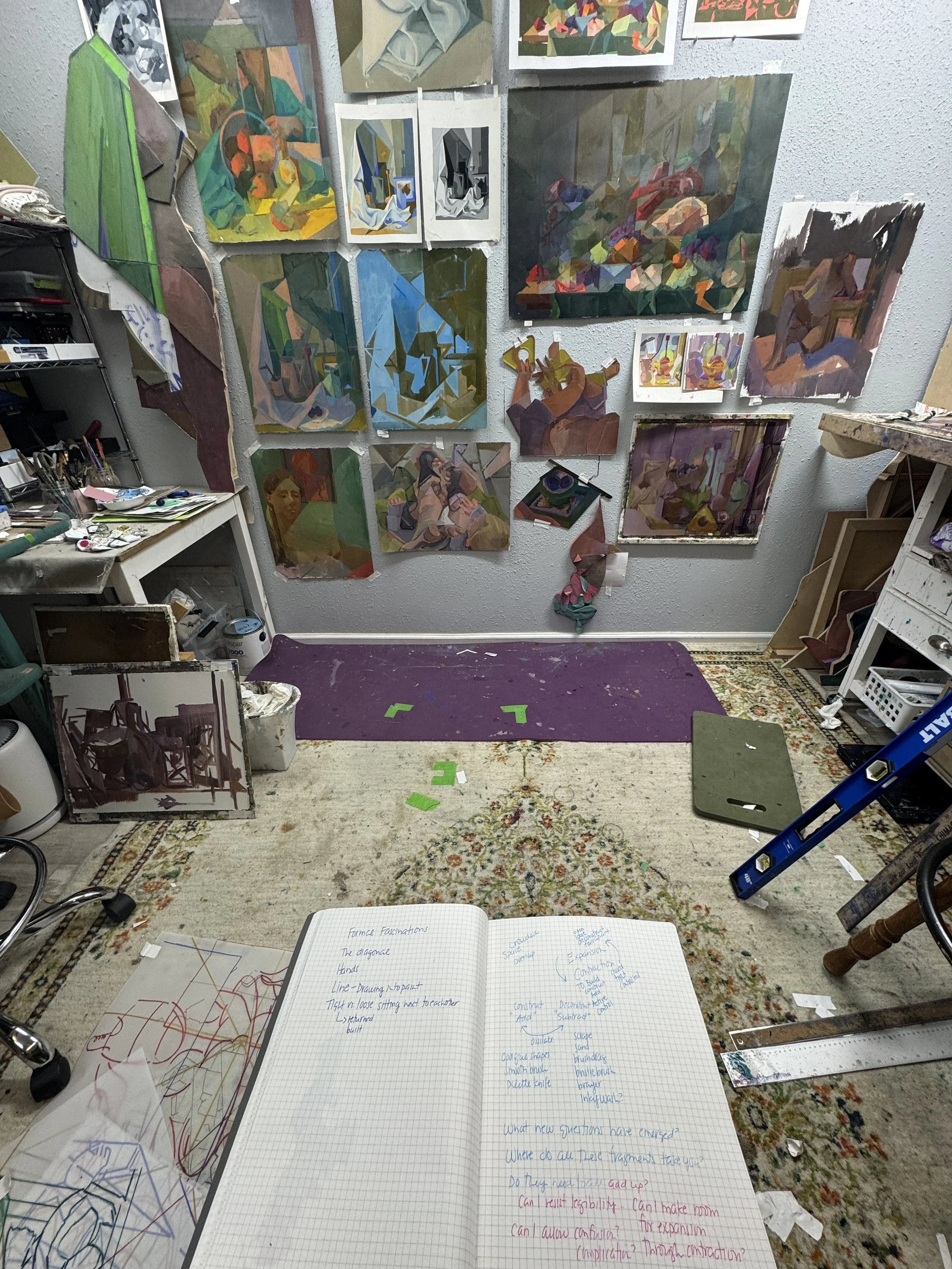
Some language fragments that came up for me:
Oscillating between modes. Constructing then deconstructing, controlled then loose. Shapes then line.
Expansion vs. Contraction; Addition vs. Subtraction
Can the painting make room for expansion through the act of contraction?
“Let it all happen to you, beauty and terror.”
Let it wreck you…who knows, something new may emerge
What would happen if I create a new space that could somehow show me how to hold it all, all the parts of myself? An overlapping, crowded space that is so gluttonously full of life to reflect the exhausting fullness of life. Climbing over piles of “stuff”/buried within it all. What happens when all these visual fragments are allowed to bump into each other, to complicate, to negate, to confuse, to make a mess?
Selecting your Primary Documents
The above reflection exercise hopefully left you with some new curiosities or questions.
Select a few paintings/drawings that you would like to stitch together.
Goal: Make a painting which combines various source materials to explore pushing and pulling tiers of space.
Pick your primary documents based on the poetic meaning to you and the connections you are curious about in your reflections. We are concerning ourselves more with getting many various form ideas, and we will edit/simplify as we go.
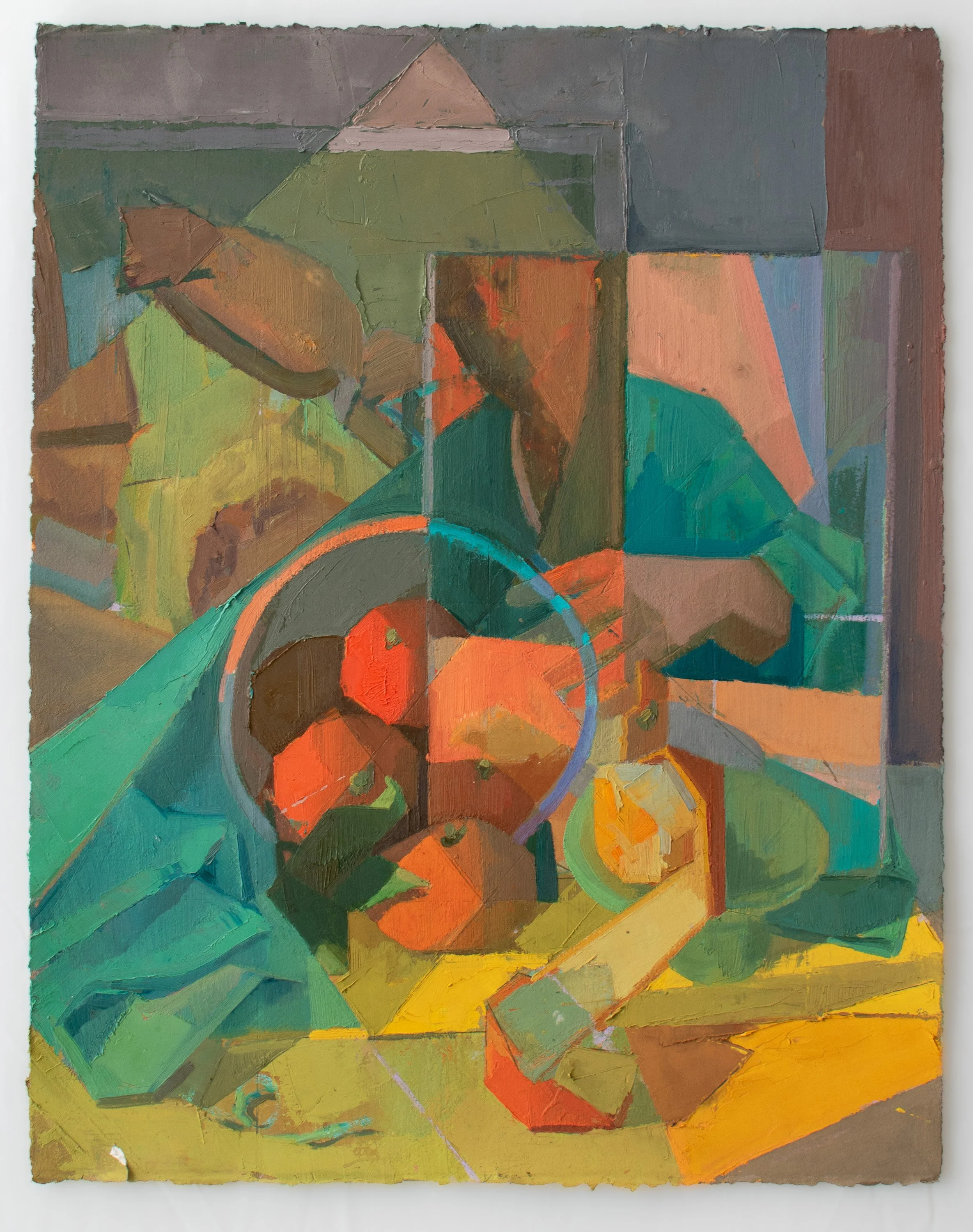
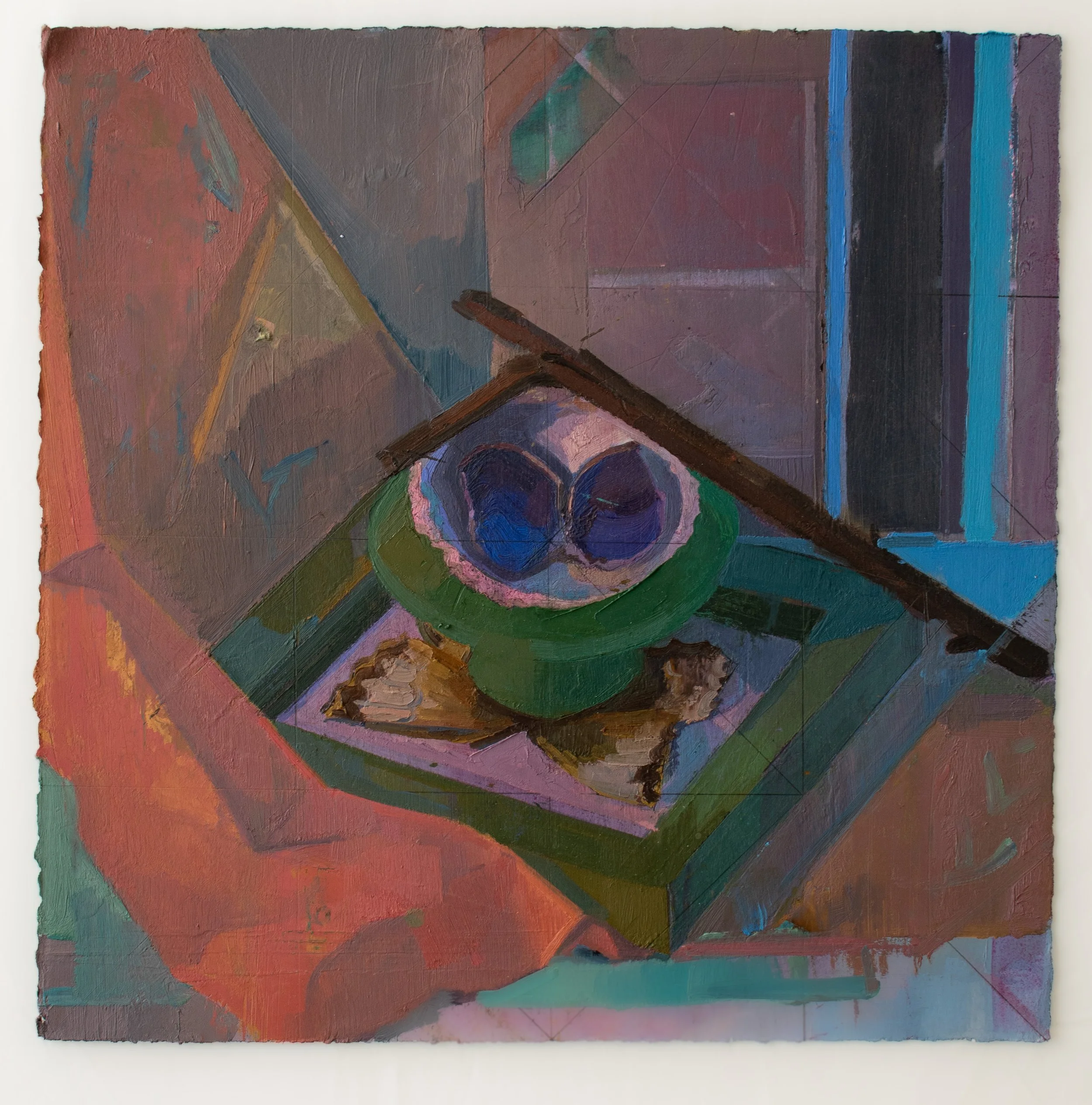
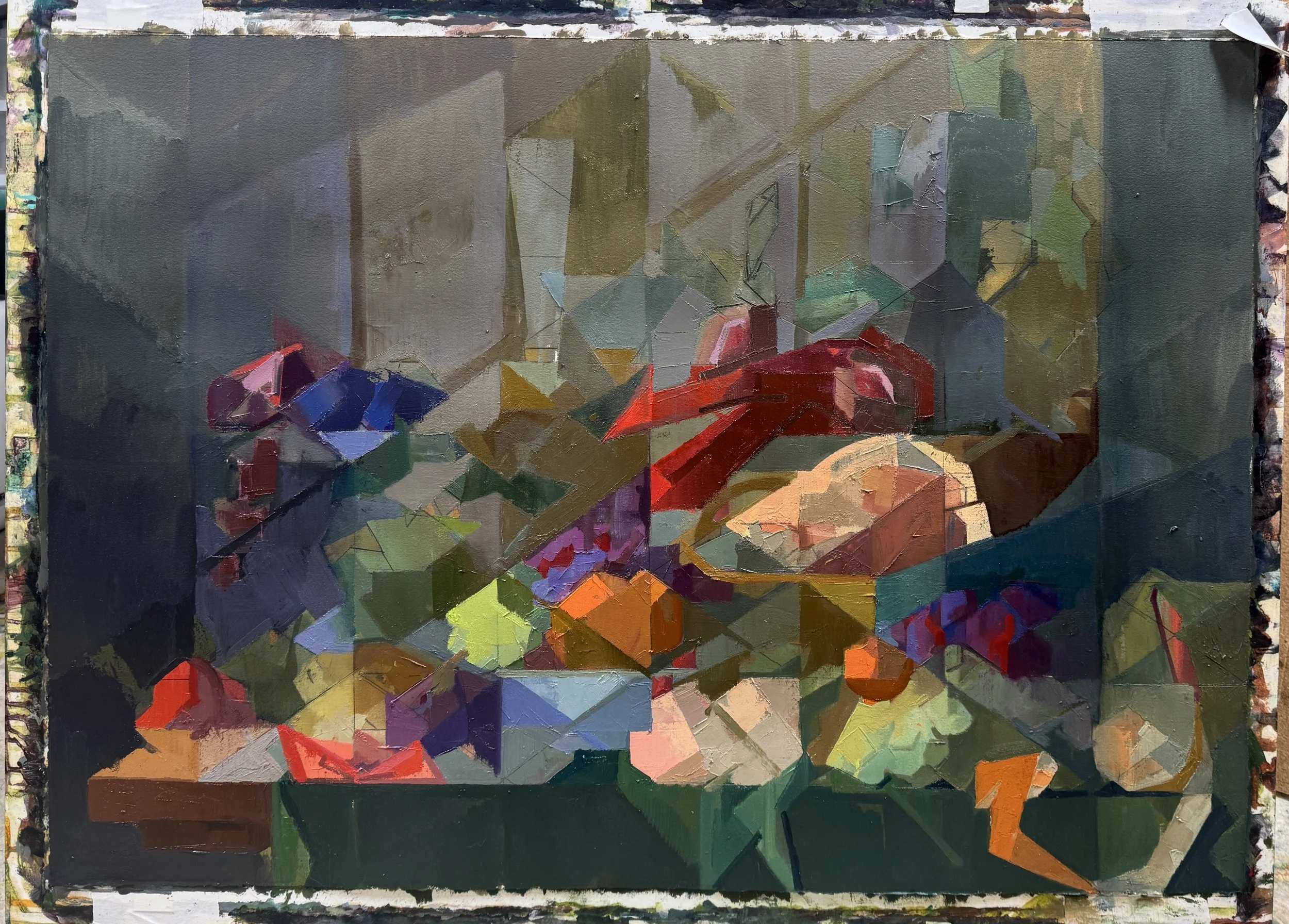
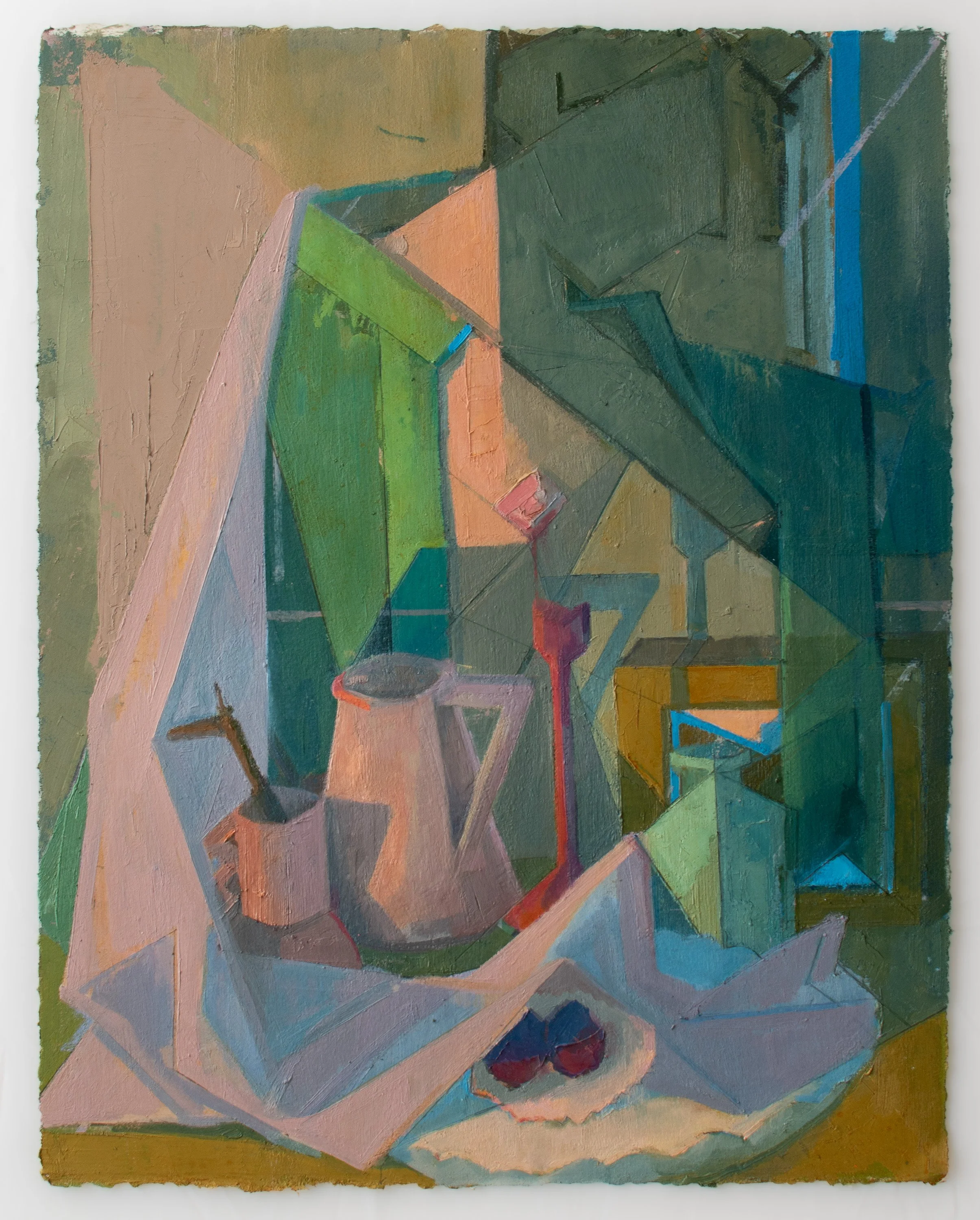
My primary documents:
All of the paintings below I selected were made with different palettes, different lighting scenarios, etc.
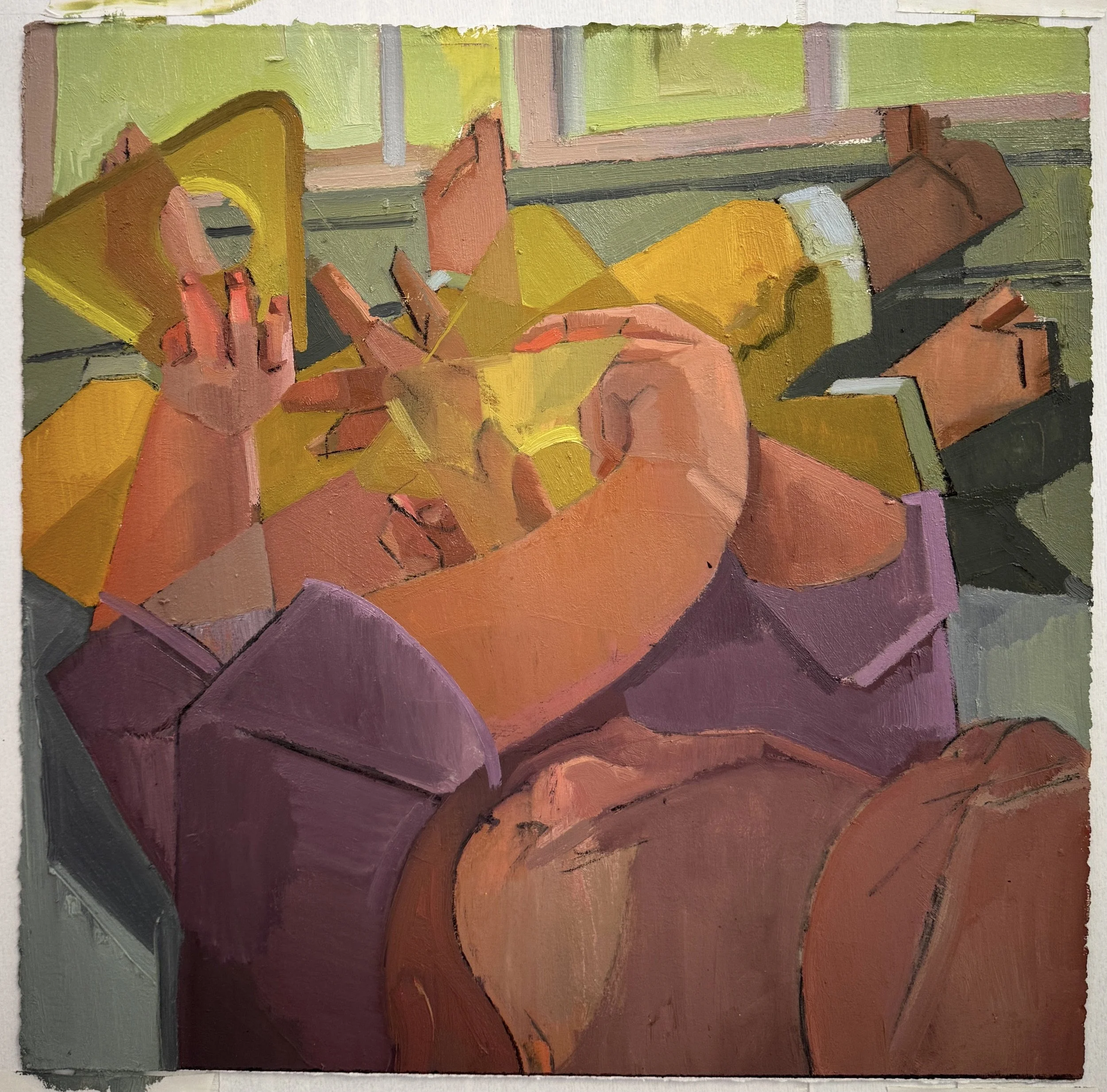
Method #1 - Cutting out Xerox copies
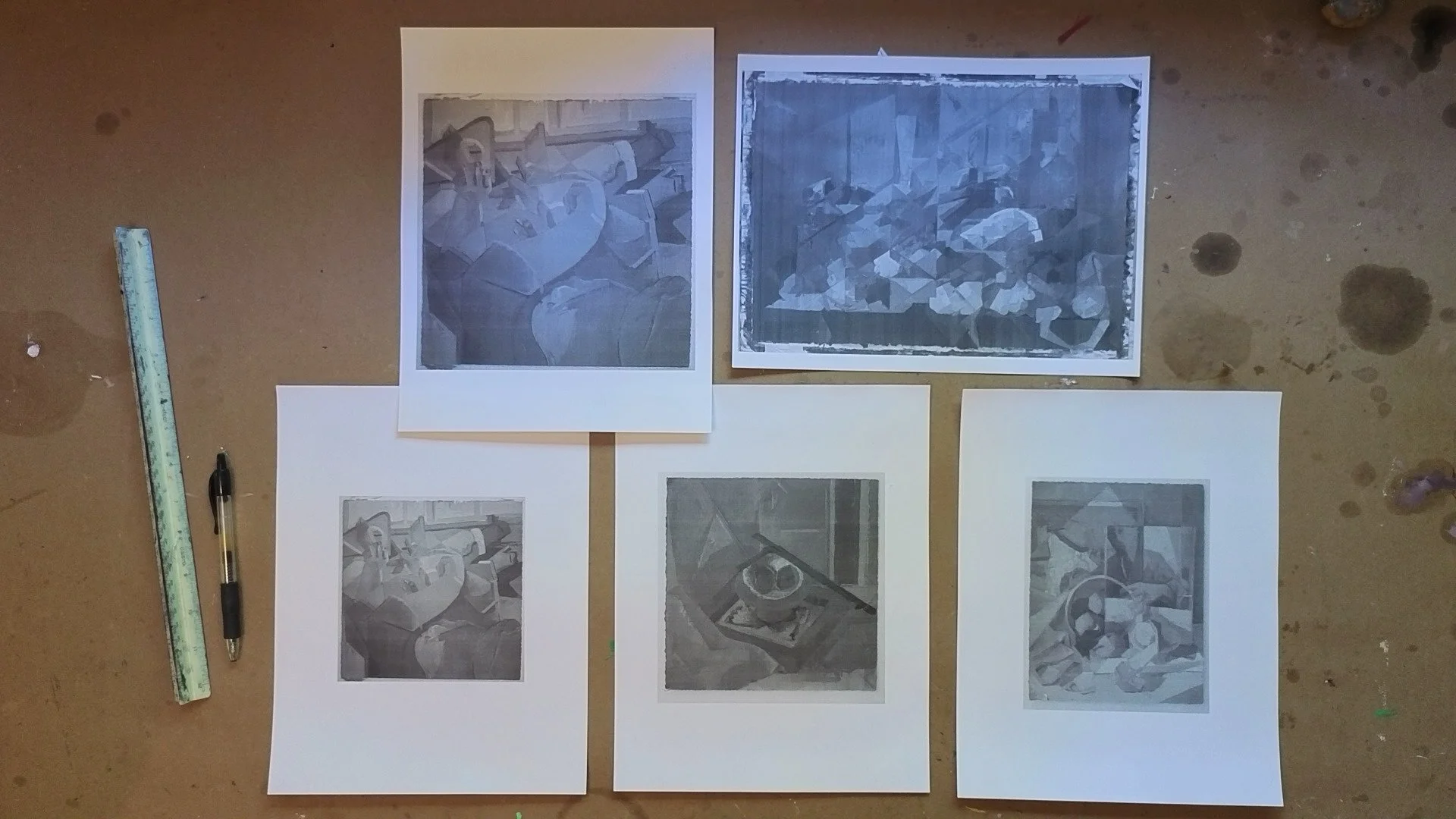
Begin by printing out black and white copies of your primary documents that you want to combine into one composition. It can be helpful to print off a few different scale options of each image to give you various sizing options to play around with
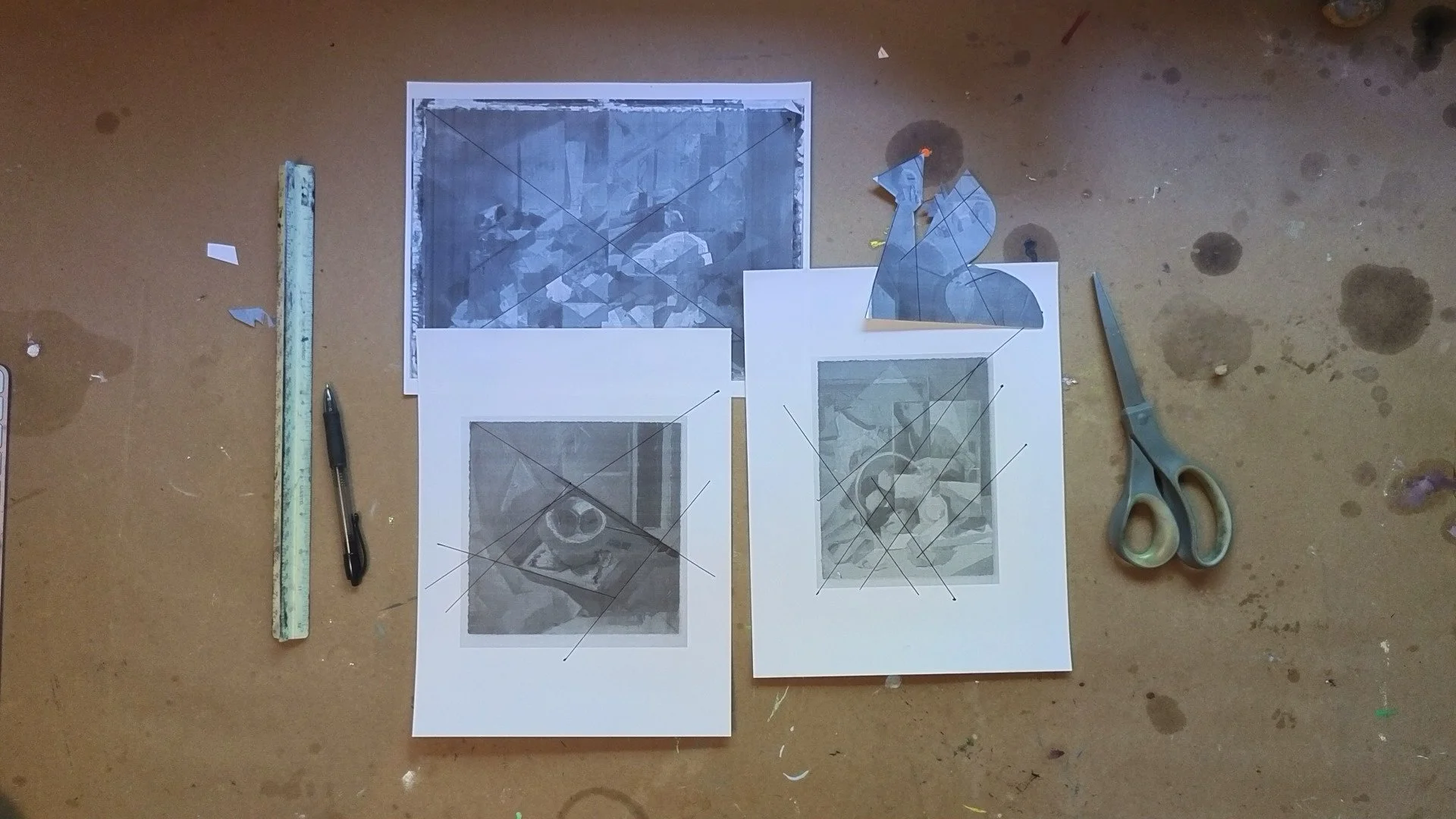
Now it is time to begin stitching these various forms together. I find it helpful to begin by drawing extension lines out from various important/interesting angles. Then I start to play around with how these angles meet up with other angles from another image.
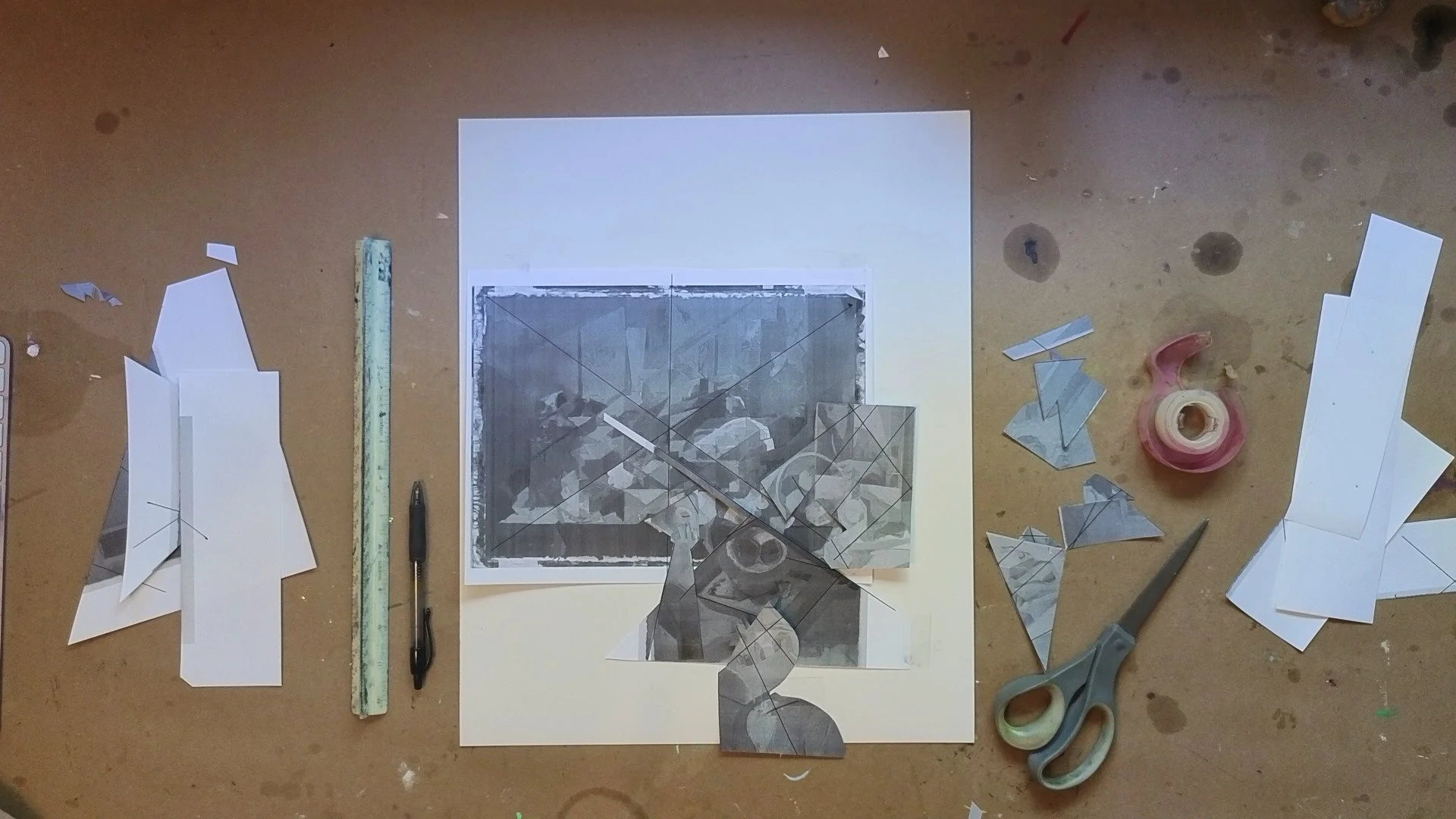
I start cutting out bits of forms and playing around with arranging
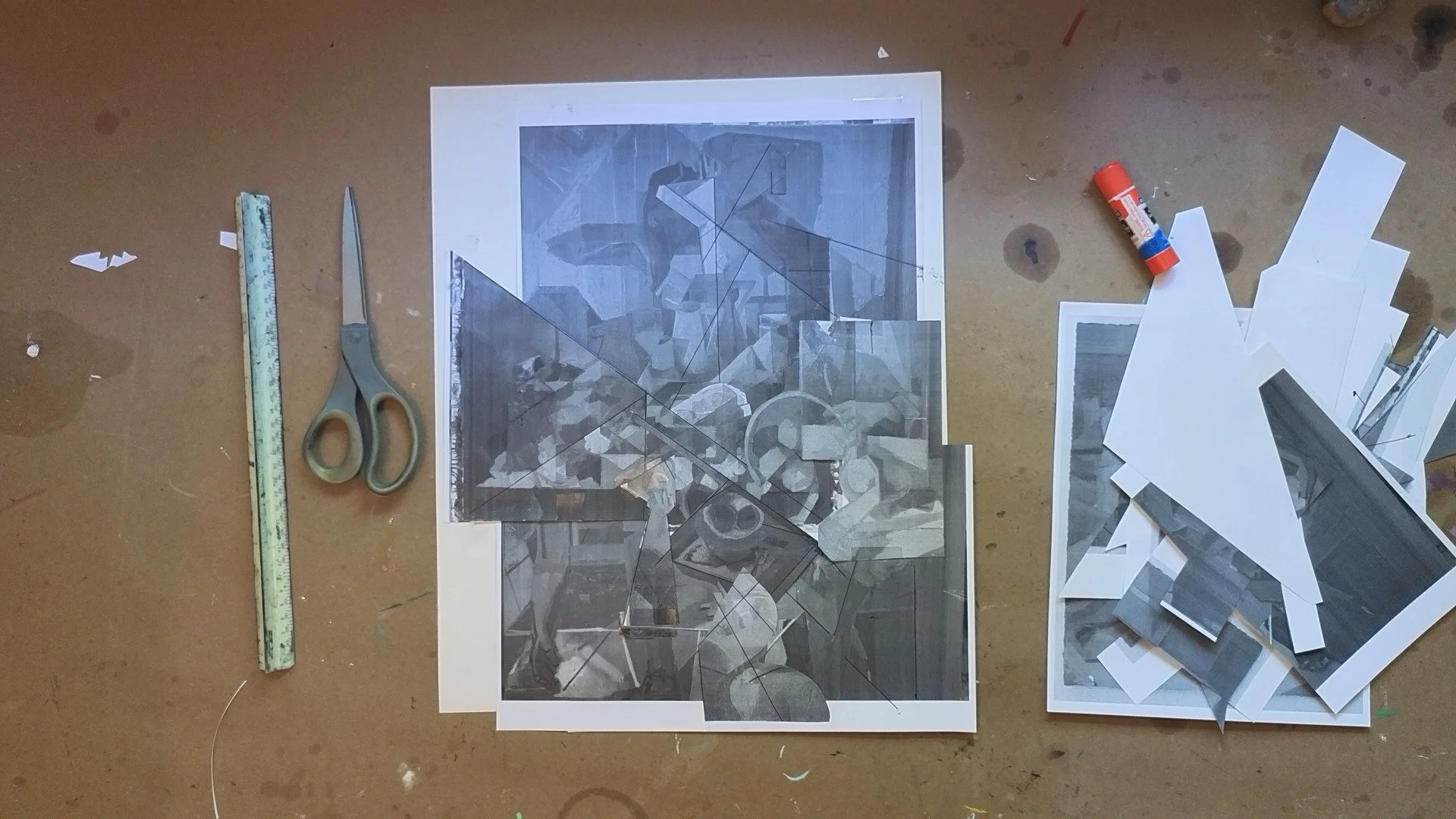
Cutting…glueing
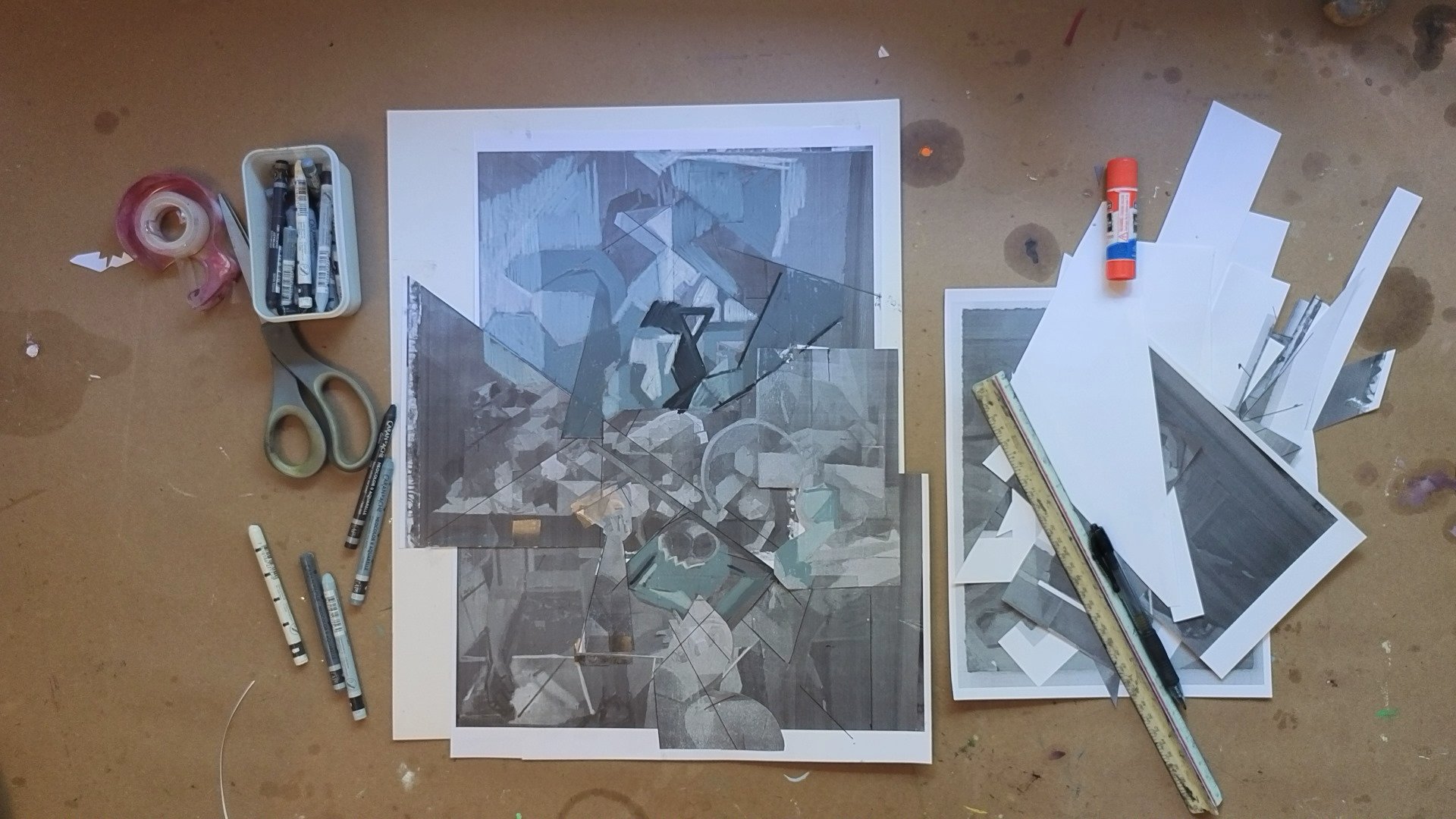
Using my crayons, I start blocking in value shapes, helping me locate certain objects and experimenting with value groupings
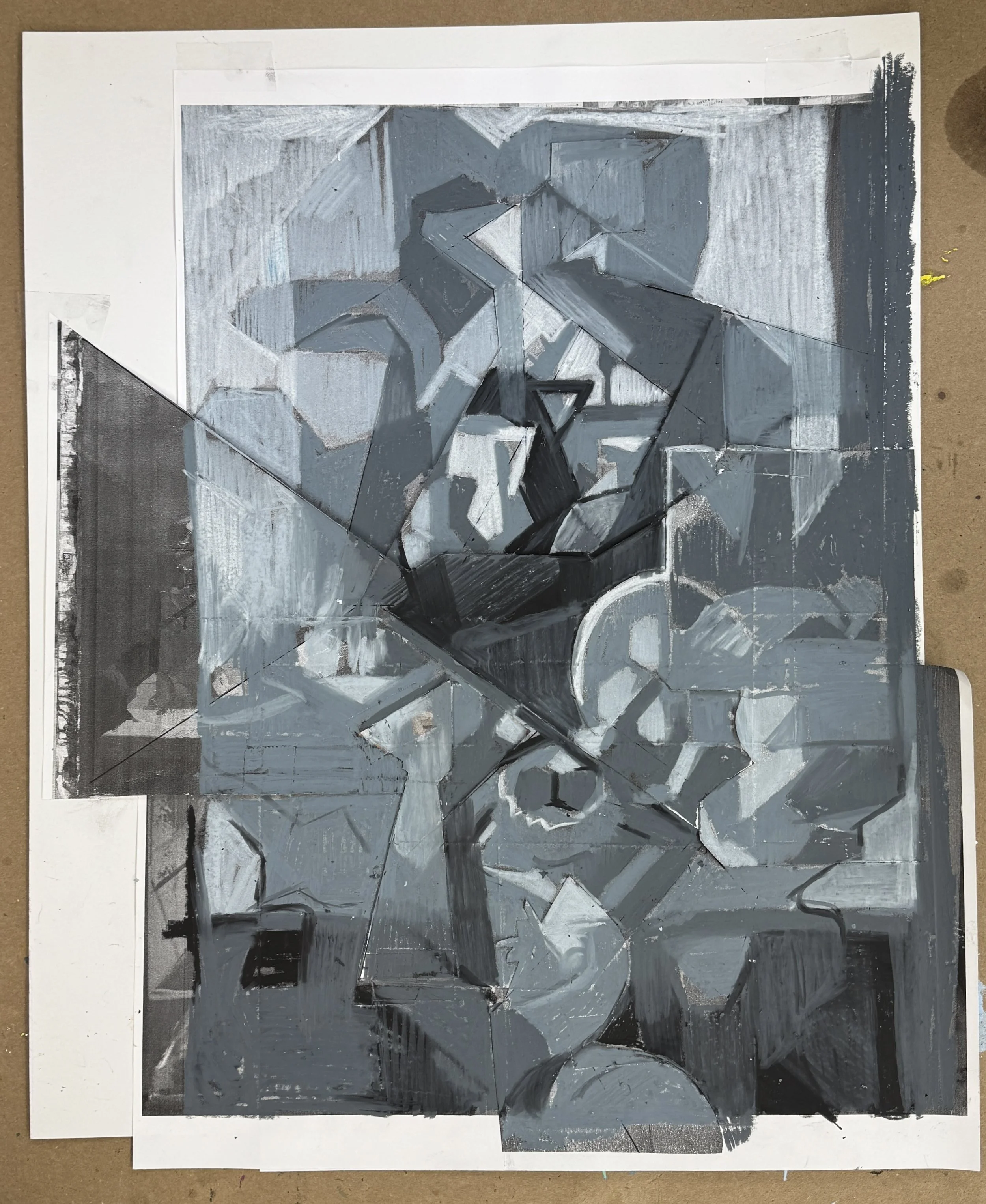
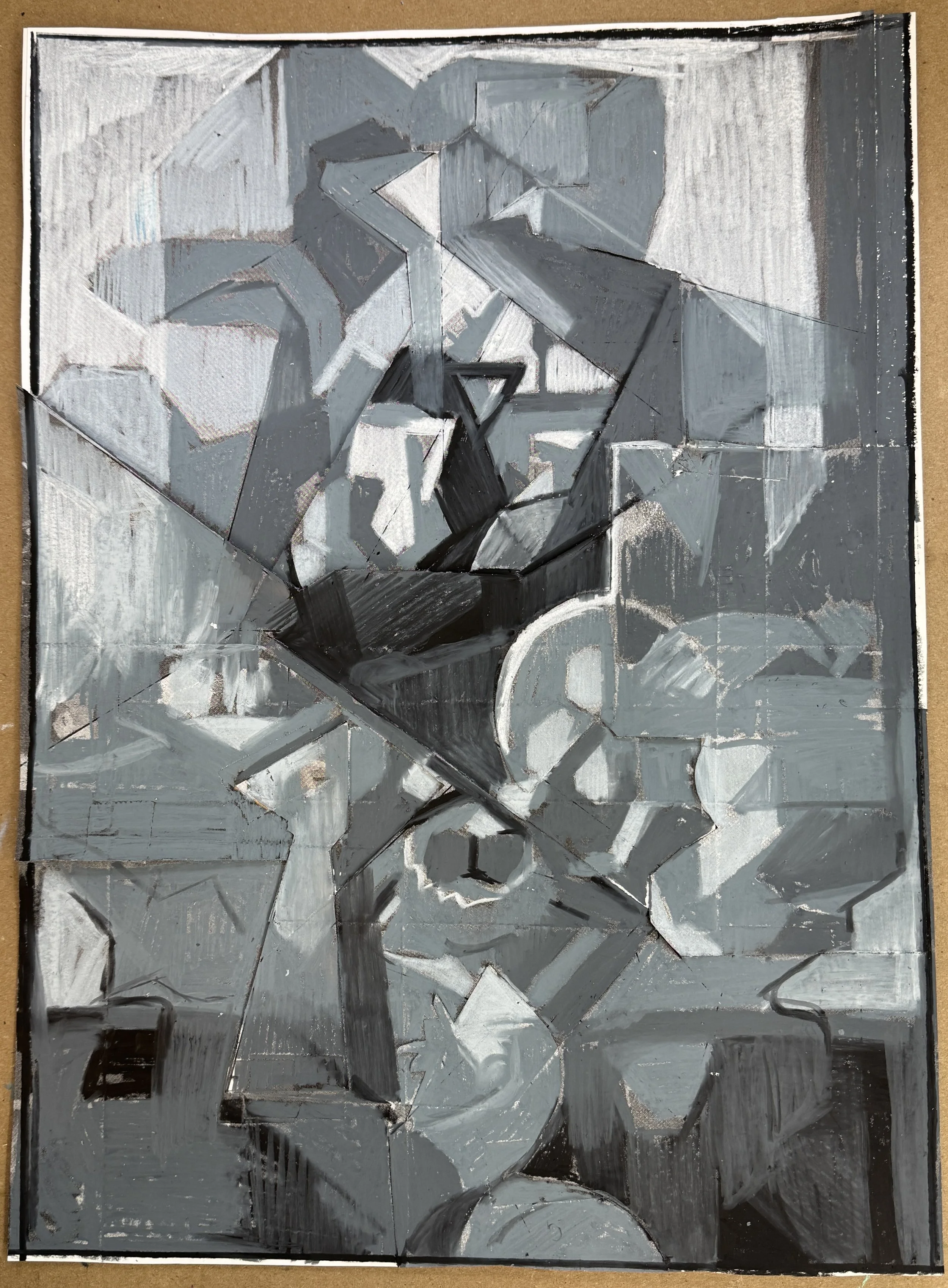
Keep playing…cutting, gluing, drawing. Print out more references, make multiples. Mess around.
Potential next investigations:
Jumping right into a tonal oil painting using just 2-3 values using just your new photo collage/drawing as your primary reference
Start an oil painting with a temperature gesture as your beginning rather than tone. Name the light as either “warm” yellow or “cool” purple
Perhaps that feels a bit too fast…..maybe make a couple of temperature gouache studies using your yellow/violet set. One with a yellow light and one with a purple light.
Method #2 - Tracing forms using Vellum/Tracing paper
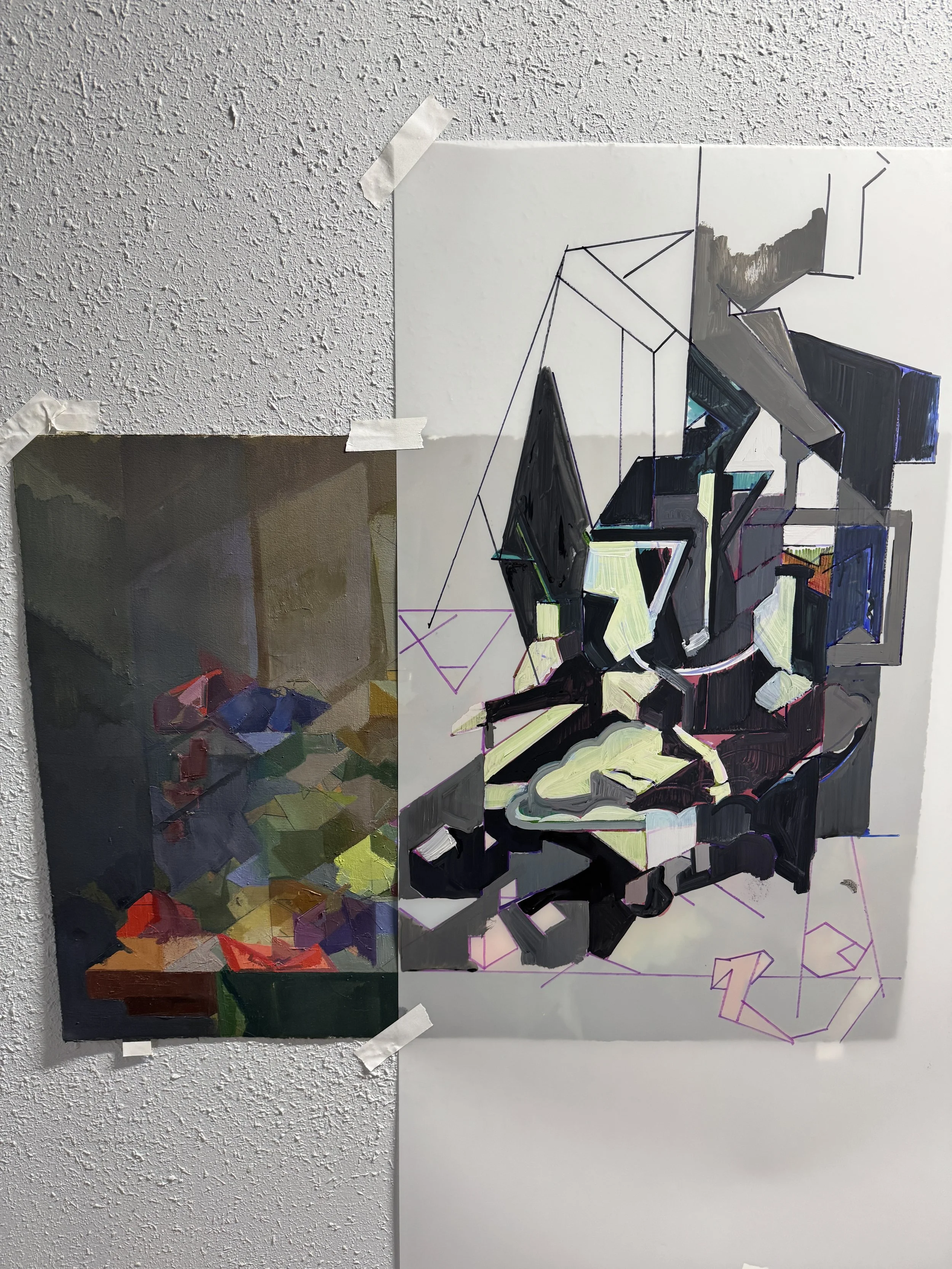
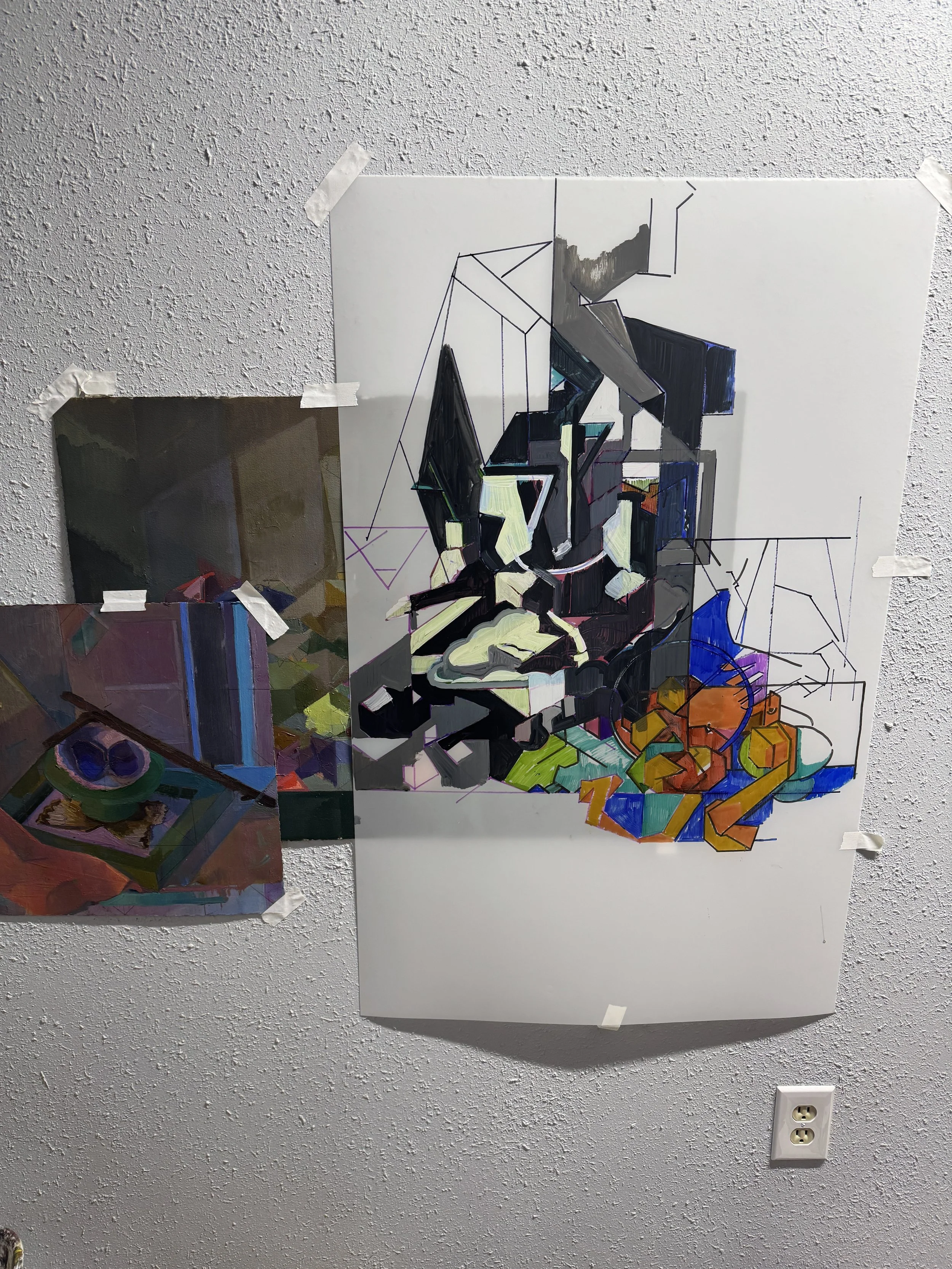
Begin by taping vellum or tracing paper directly over one of your paintings. I started by simply tracing the forms using various colored Sharpies, just messing around. Then, when I got absolutely lost in lines, I transitioned to black-and-white acryla gouache to start navigating the overlap of shapes. This helped me begin to negotiate what is in front, what is behind, what gets overlapped and therefore omitted, what stays?
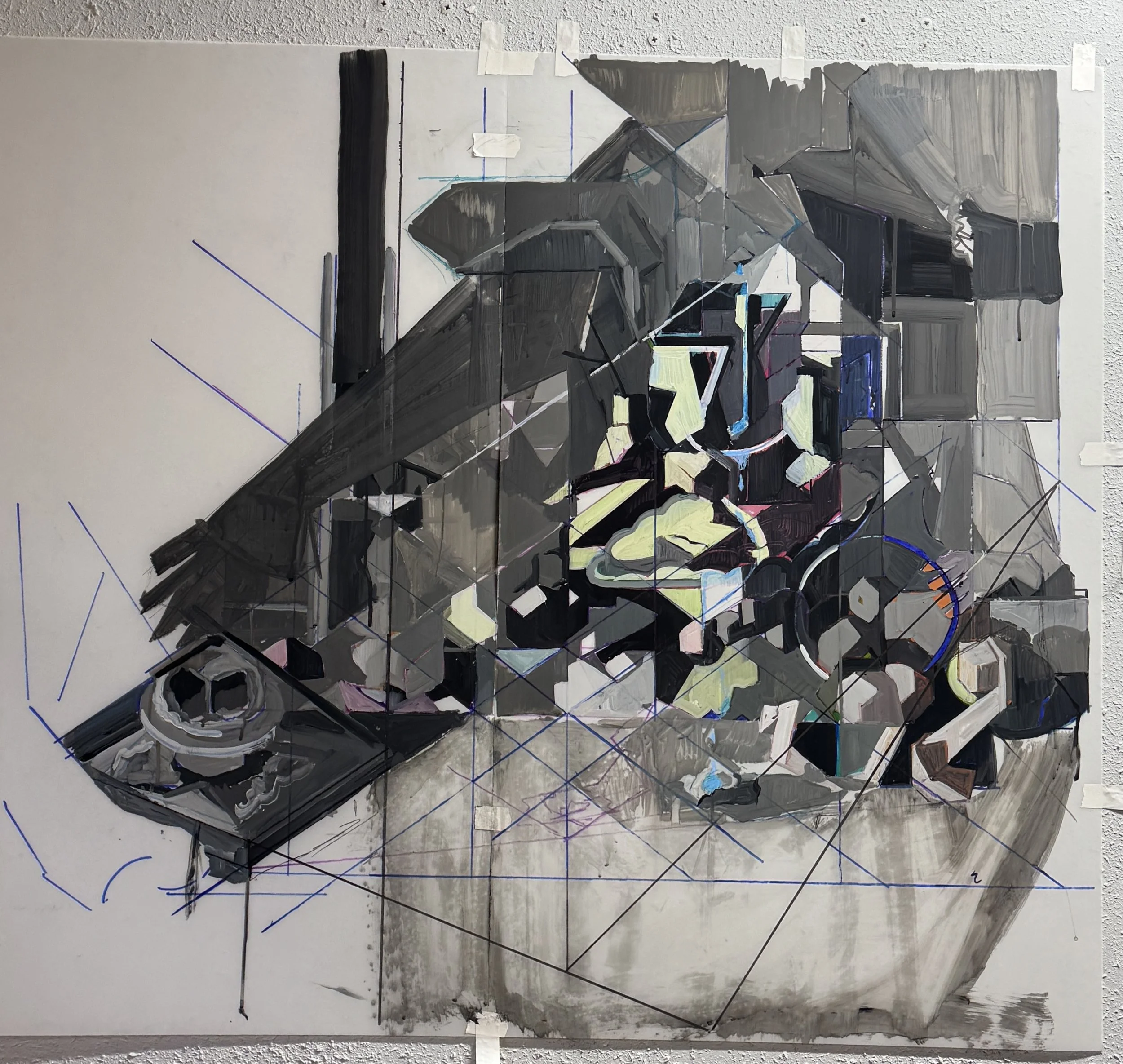
Starting to get excited….But I wanted more! Even more objects, even more overlap, which led me to a new curiosity.
What if….I put objects in front of a figure painting?
I had an abandoned multi-figure painting that I had started about 6 months ago. I like moments of her, but she never felt done to me. I decided to start overlaying the vellum directly onto this old figure painting. Asking myself….what if I put all these still life objects “in front” of the figures so that you almost have to visually climb over all these objects to find them?
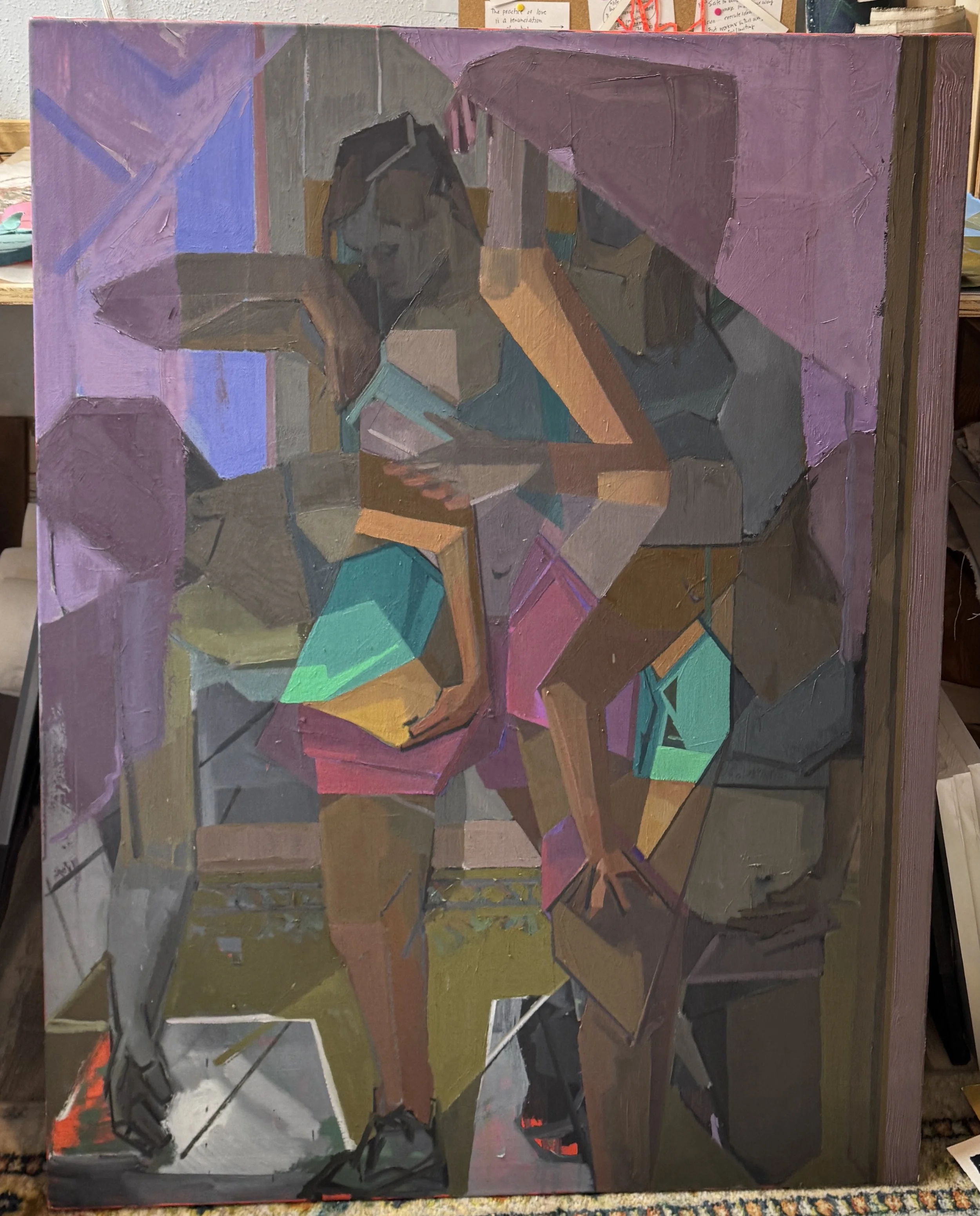
36” x 48” Oil on canvas
Then I started tracing all my primary documents on individual sheets of vellum
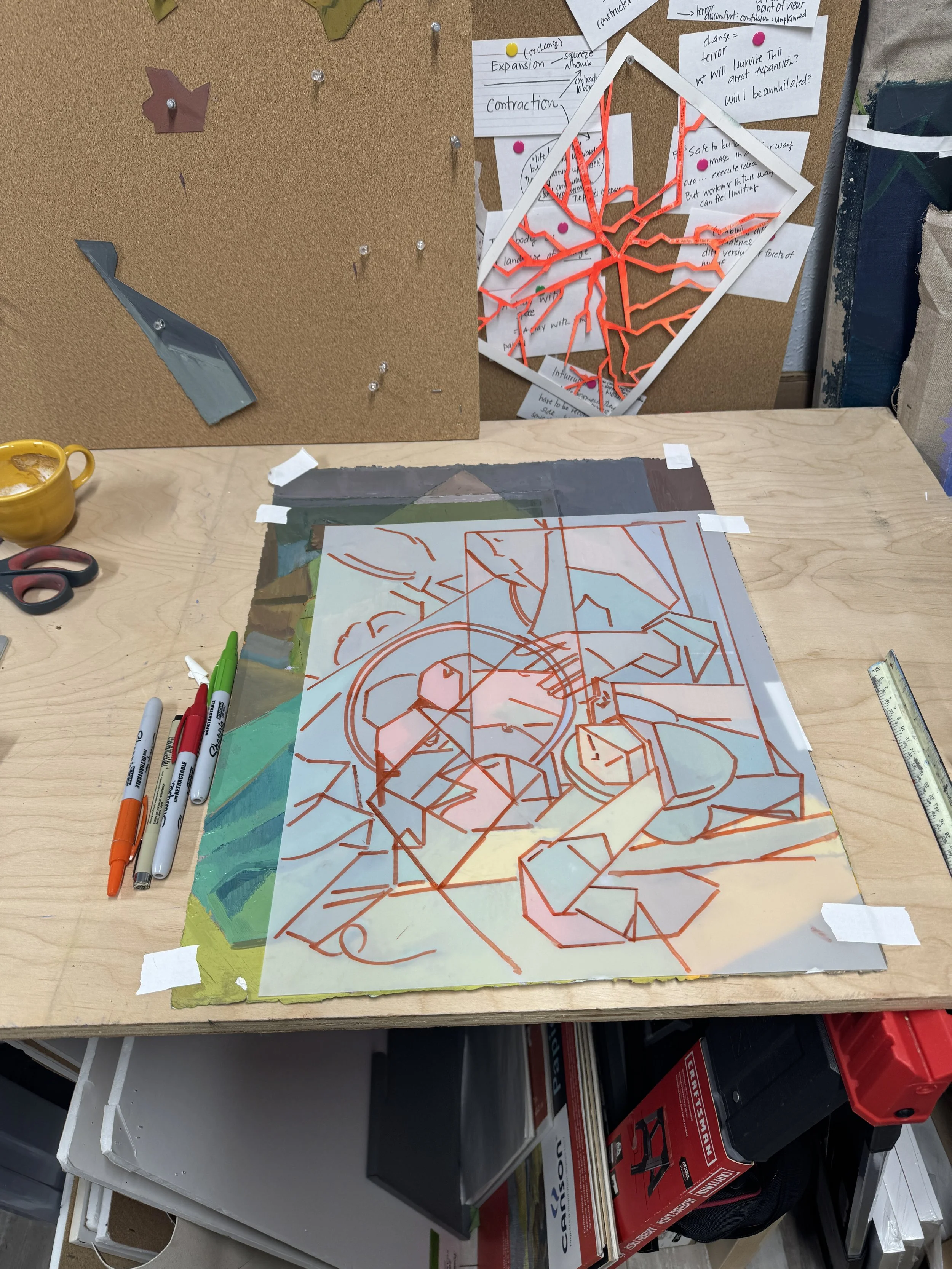
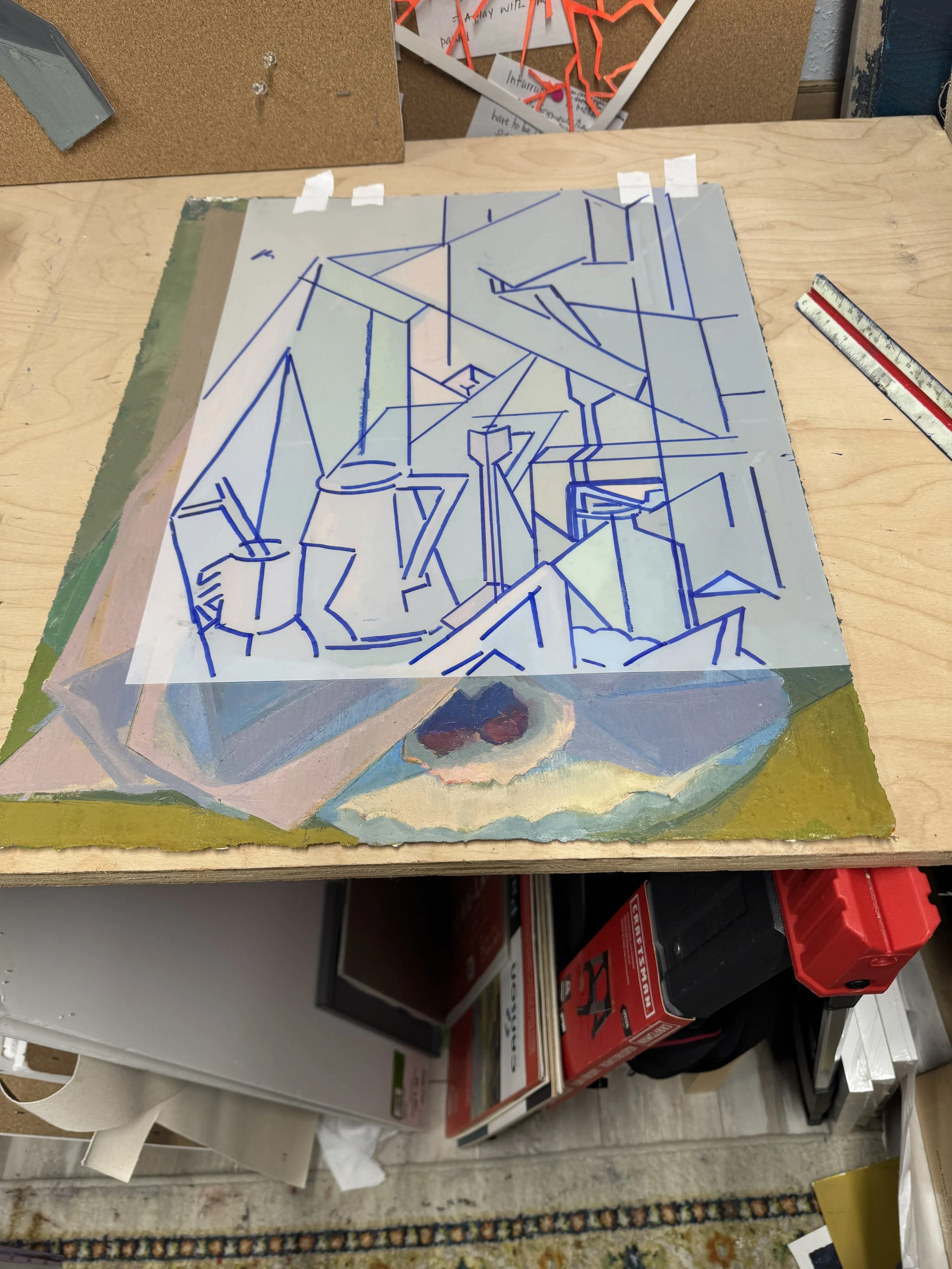
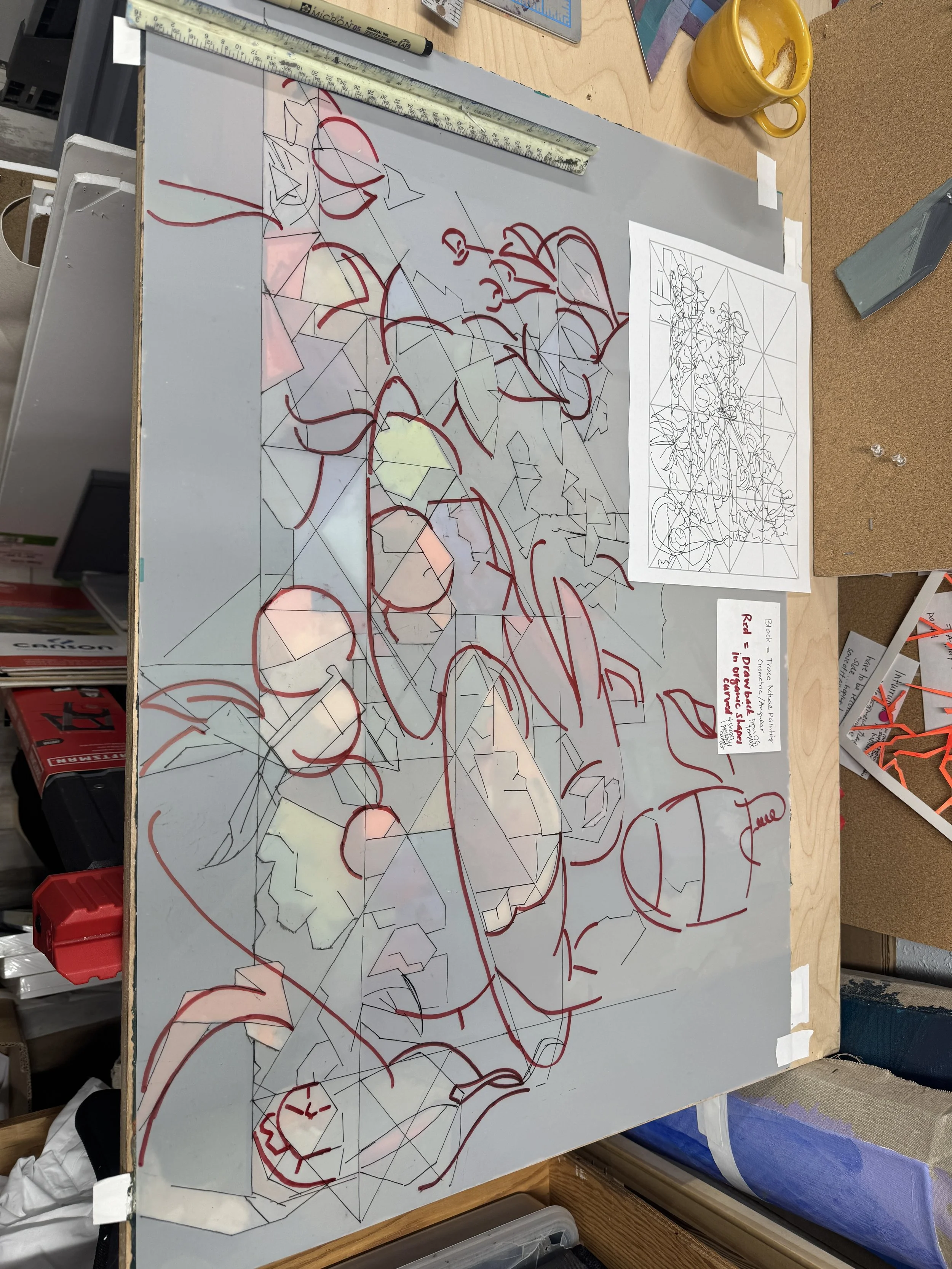
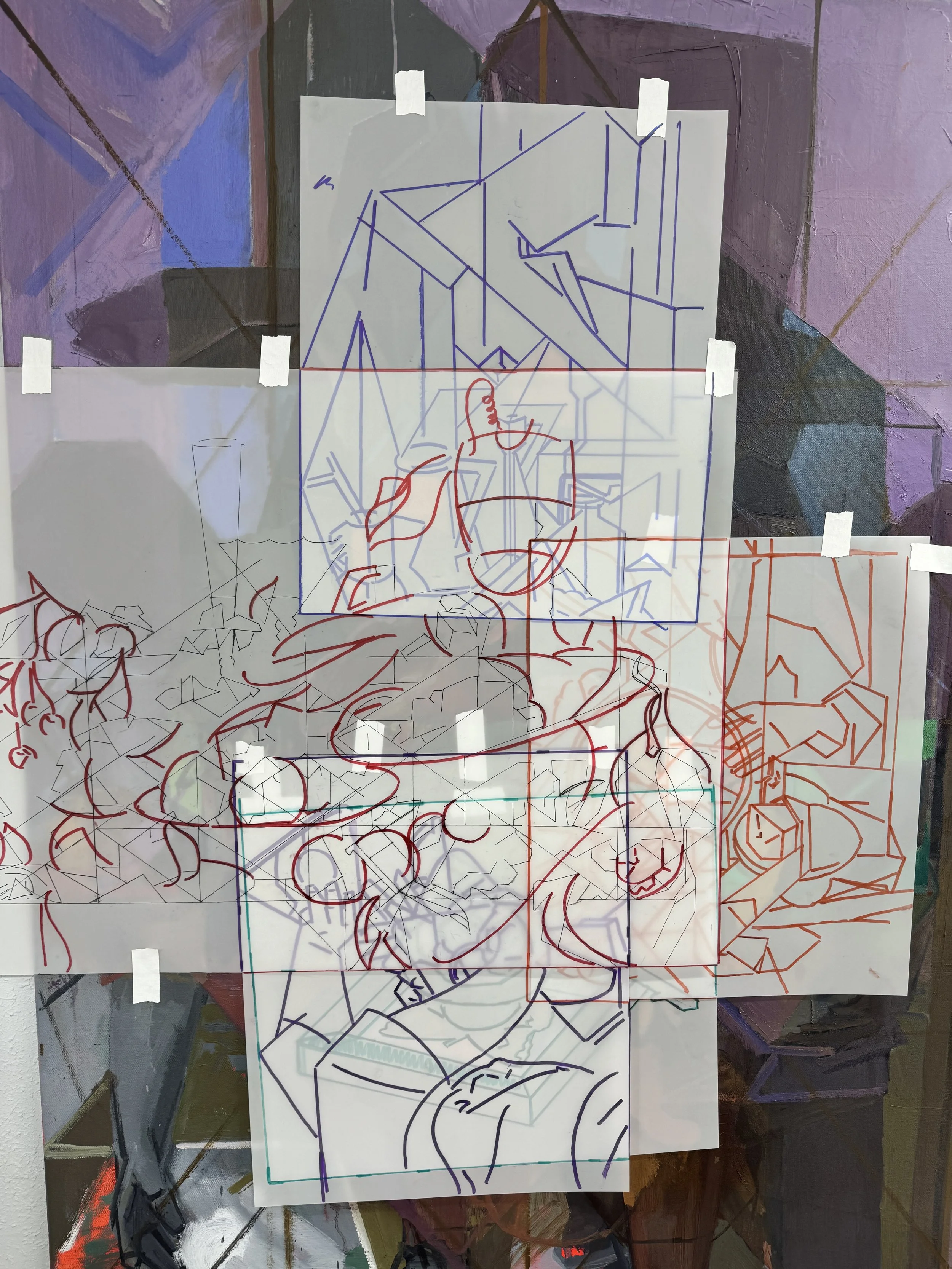
Because the vellum is semi-opaque, I could see all the layers through each other and was negotiating what shapes I was really attracted to, which ones I was not, and therefore didn’t mind overlapping with another. I also used many extension lines to help find bridges or connections between the gestures of different forms.
Once I settled on a general placement, I then used graphite transfer paper between the canvas and the vellum and retraced the forms, which left a graphite imprint directly onto the canvas.
This felt like enough of a launching point for me to start painting directly onto the canvas and just playing around. I was too excited NOT to do that! It was fun to see how the previous painting’s shapes interacted with the new shapes I was painting. I was generally using a yellow violet blood line and satelliting into it using my primary documents as color notes but by no means trying to color “match” those decisions directly.
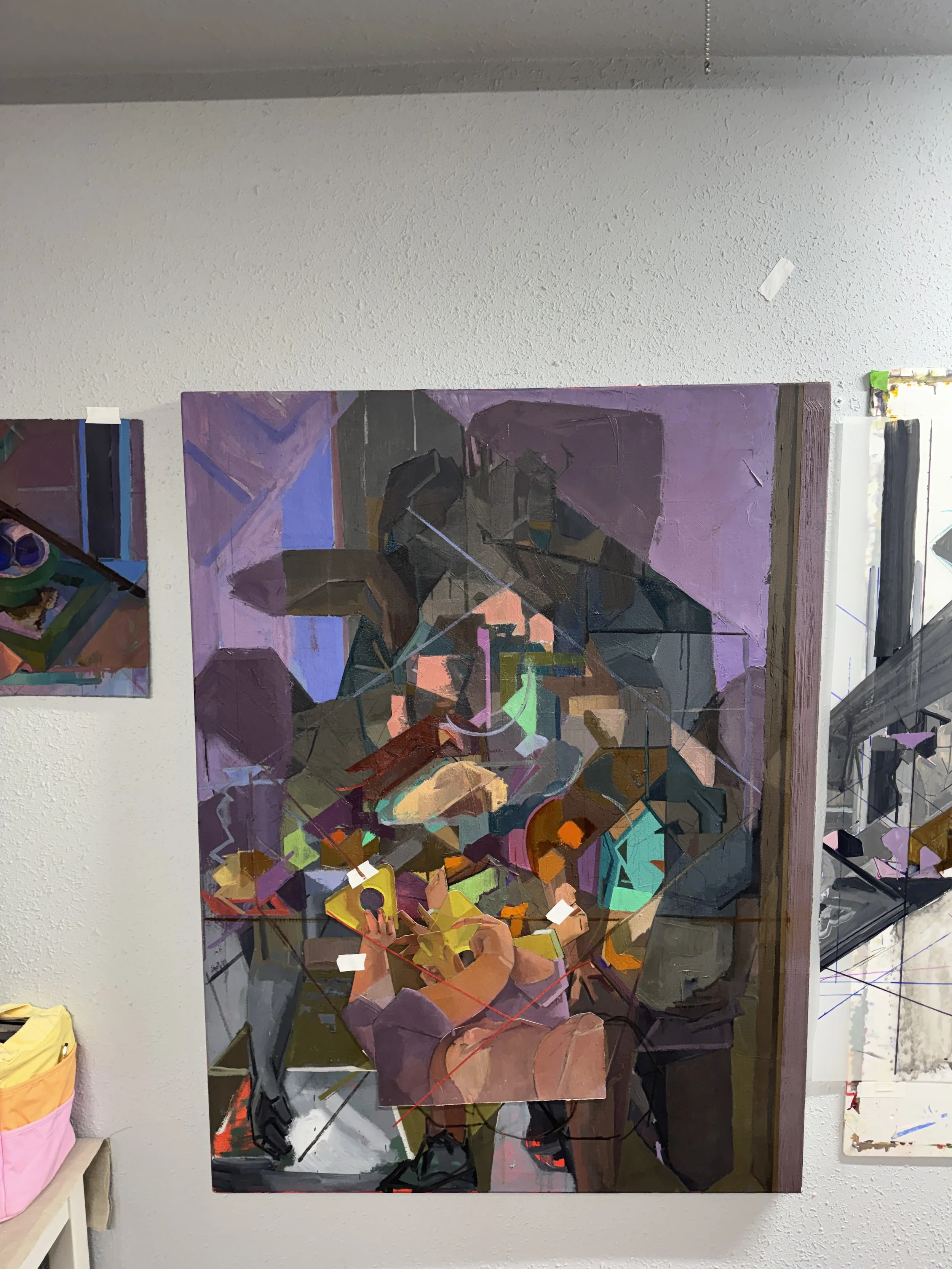
Start playing….get weird. None of it has to make sense. Just shove a bunch of stuff together; you can edit later. Allow it all to be too much…what’s the worst that can happen?